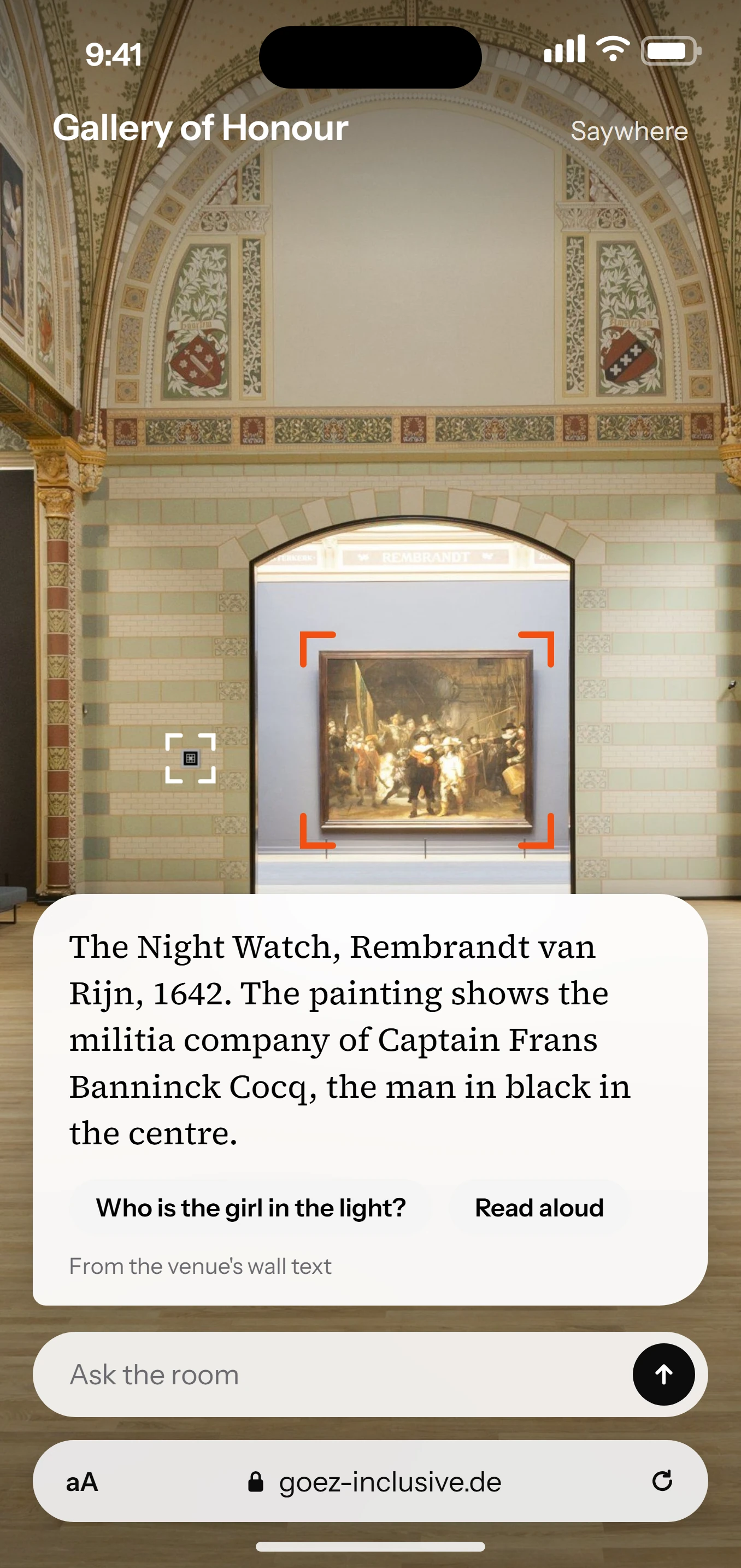
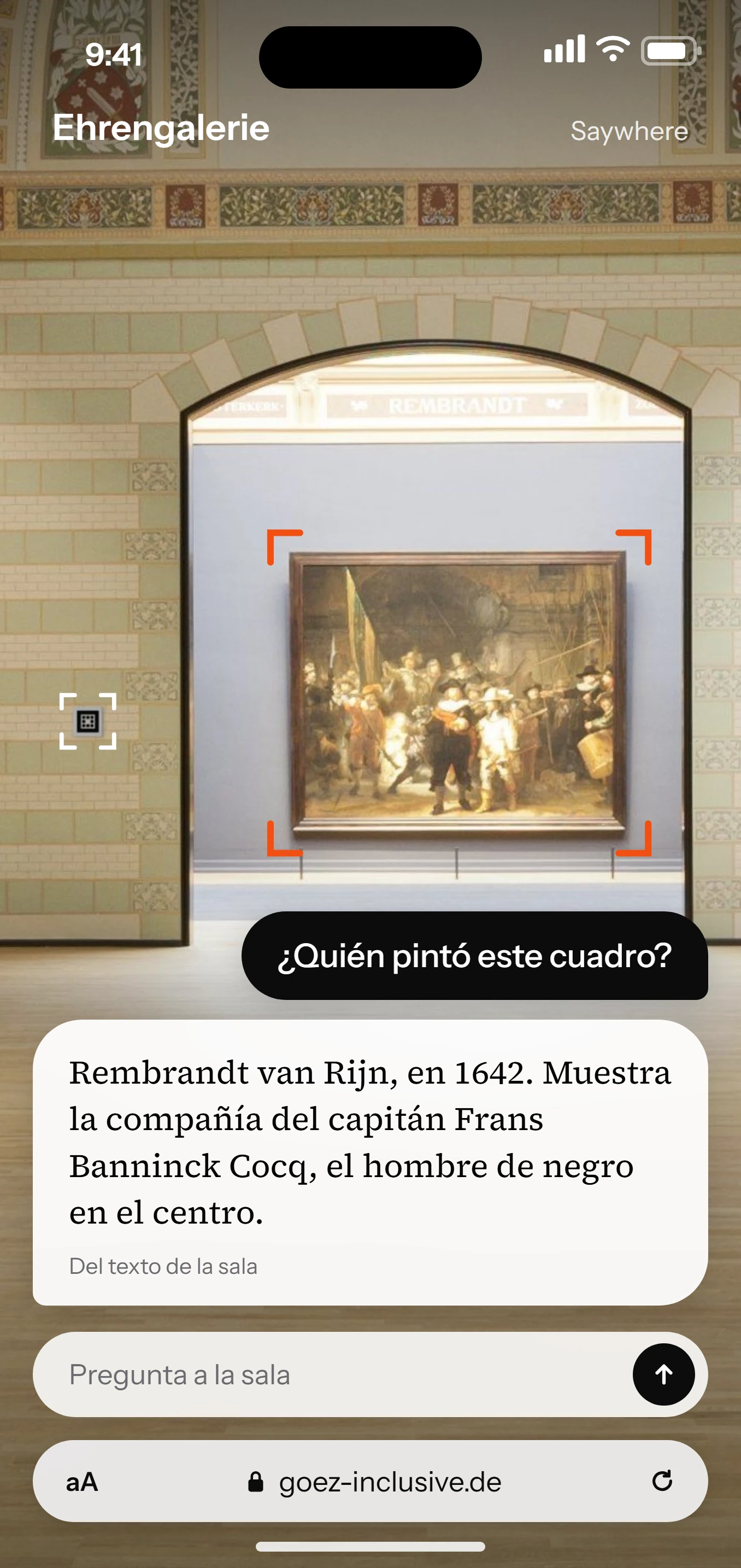
The Night WatchRembrandt van Rijn, 1642In 1715 it was trimmed on all sides so that it would fit between two doors in Amsterdam's town hall.
Isaac and RebeccaRembrandt, c. 1665–1669, known as “The Jewish Bride”Van Gogh said he would give ten years of his life to sit in front of this painting for two weeks.
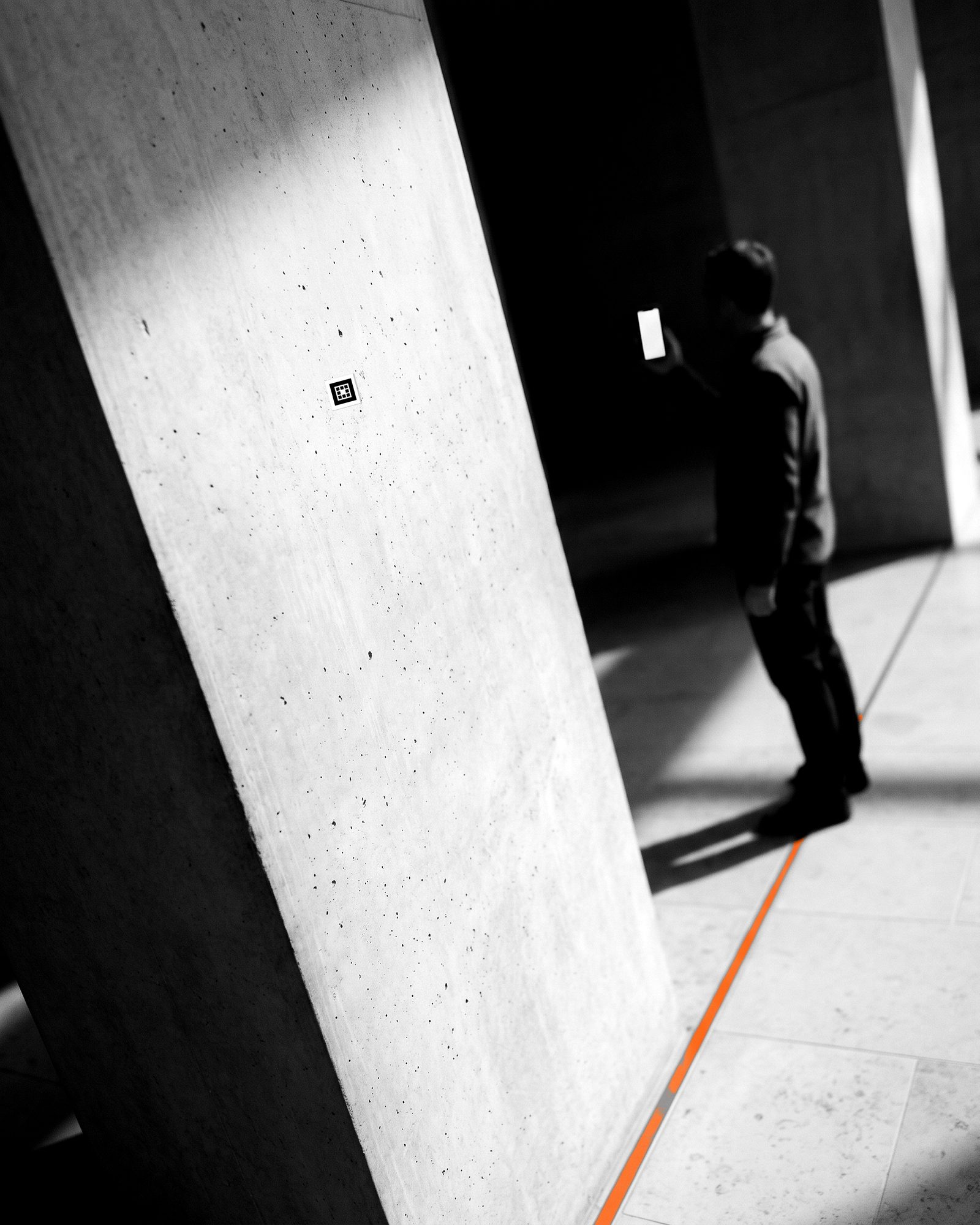
WaymarkLocation recognised: Gallery of HonourSmall and discreet on the wall. Here Saywhere knows where your visitor is standing.
The Threatened SwanJan Asselijn, c. 1650In 1800 it became the first painting bought by the National Art Gallery, the forerunner of the Rijksmuseum.
Wall textTo read and to listen toSaywhere reads it aloud and answers questions about it.
The Gallery of HonourPierre Cuypers, opened in 1885The room leads the eye straight to the Night Watch.
River Landscape with FerrySalomon van Ruysdael, 1649Horses, cows, dogs and eleven people crowd onto the narrow ferry.
BenchFrequent question at this spot“How far is it to the exit?”
ToiletsThrough the arch on the rightSaywhere shows the way with arrows in the camera view.
LiftThrough the side room on the leftIf your visitor asks for the lift, arrows lead the way.
Move through the room
Example of how Saywhere will later label several artworks in the picture. Today Saywhere recognises the room at the Waymark and guides with arrows. Photo: Rijksmuseum (CC0)
Ask the room.
gOEZ is a digital museum guide and wayfinding system with AI from Hamburg, Germany. Saywhere answers your visitors' recurring questions right at the artwork, in their language. Your team gains time for tours, conversations and everyone who needs personal help.
When a venue has to save money, front-of-house hours are often the first to go. Visitors still ask who painted the picture and where the lift is. If nobody is there, the visitor walks on without an answer.
Today
Your team answers the same questions every day.
The wall text speaks one language, perhaps two.
If nobody is nearby, the question goes unanswered.
You only hear in passing what visitors want to know.
With Saywhere
Saywhere handles the routine questions, so your team has time for tours and conversations.
Every visitor reads and asks in their own language.
The answer comes instantly, at the artwork, from your own content.
Every month Pulse shows what was asked and where answers are missing.
Frag den Raum · Ask the room · Pregunta a la sala · Demande à la salle · Frag den Raum · Ask the room · Pregunta a la sala · Demande à la salle · Frag den Raum · Ask the room · Pregunta a la sala · Demande à la salle ·
Every place has something to say · Every place has something to say · Every place has something to say · Every place has something to say · Every place has something to say · Every place has something to say ·
Wo ist Halle 3? · Is there a talk today? · ¿Dónde puedo comer? · Wo ist Halle 3? · Is there a talk today? · ¿Dónde puedo comer? · Wo ist Halle 3? · Is there a talk today? · ¿Dónde puedo comer? ·
9:41
Hall 3, aisle BSaywhere
Location recognised
Where can I find the design exhibitors?
In Hall 3. Go straight down this aisle and turn right at the second pillar.From the fair's hall plan
Gibt es heute einen Vortrag über Design?
Ja, um 14 Uhr auf der Bühne in Halle 3.Aus dem Veranstaltungsprogramm
¿Dónde puedo comer algo?
En el área de restaurantes, junto a la entrada oeste.Del plano del recinto
Ask the room
aAgoez-inclusive.de↻
Camera image: AI image. Example. Phrased answers like these come with the language model in the pilot.
Your visitor asks in their language. The room answers.
Less work for your team
Less routine. More time for your visitors.
The same visitor experience, even with fewer staff: that is our assumption. In the pilot we test it with your figures.
Fewer routine questions at the desk and in the galleries.
“Who painted this?”, “Where is the lift?”: Saywhere answers questions like these right at the artwork, for many visitors at once and in their language. Whoever is on duty stays available for visitors who need personal help.
No texts to write from scratch.
The drafts come from what your venue already has: wall texts, catalogues, PDFs. In the pilot we deliver them. Your team checks every sentence against its source and approves it, and the language versions are created automatically.
Nothing to maintain.
Waymarks are printed, with no power and no battery. There are no devices to charge and no building work. If a Waymark goes missing, the CMS tells you and we print a new one.
The monthly report is ready.
Every month Pulse shows how many visitors asked, in which languages and where answers are missing. You don't have to compile the figures for management and your funding body yourself.
What you no longer need
App
Saywhere runs in the browser, on the visitor's own phone.
Scanning
No close-up scanning: the phone recognises the Waymark from a distance. The browser asks once for camera access.
Workload
Your team writes nothing new: the drafts come from what you already have, and in the pilot we deliver them.
Account
No sign-up, no names, the data stays in the EU.
How it works
One system, four parts.
WaymarkMementoSaywherePulse
The location.
A small printed location marker on the wall, without power and without maintenance. The phone recognises it from a distance, in tests over 15 metres with a 12 cm sign.
A small printed location marker on the wall, without power and without maintenance. The phone recognises it from a distance, in tests over 15 metres with a 12 cm sign.
The AI agent for your venue turns PDFs, wall texts and catalogues into drafts for every room, every sentence with its source. In the pilot we deliver the drafts.
Saywhere talks to your visitors in their language.
Saywhere is the AI agent in the room, in the browser, without an app. Every answer comes only from content your team has approved.
Your text first
At every spot Saywhere shows your text with one tap, read aloud if wanted. Below it are questions your visitor can continue with.
Their own language
Your visitor asks in their language and gets the answer in the same language. The versions are created automatically from your texts once you approve them.
Only your content
Every answer comes from your approved content and names its source. If something isn't in it, Saywhere says so openly.
The way there
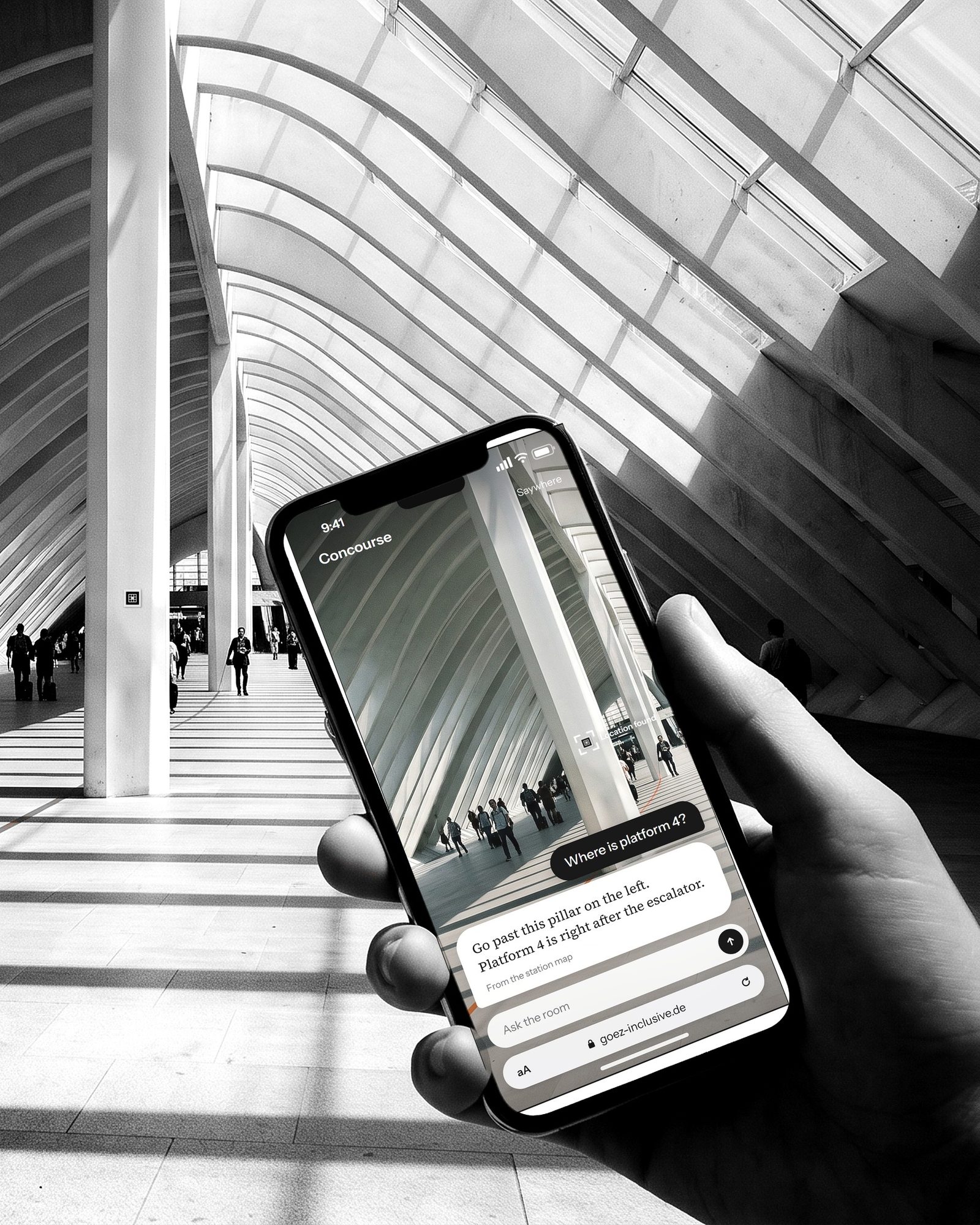
If your visitor asks for a place in the venue, arrows in the camera view lead the way, from Waymark to Waymark.
A few Waymarks for a whole room.
Saywhere needs to know where your visitor is standing. A few Waymarks, far apart on the walls, are enough. The CMS reads the plan of your venue from your PDF and suggests the rooms; your team accepts what is right. When a new version comes, it shows what has changed.
The plan of your venueRoom names come from your PDF, your team adds what is missing.
A few Waymarks on the wallsWe place them far apart on the walls, small and discreet, without power and without maintenance.
CoverageThe phone recognises a Waymark from a distance, in tests over 15 metres with a 12 cm sign. The CMS estimates the area covered from your floor plan; we check it on site during the walk-through.
A Waymark is in view from almost every spot
Map studio
Plan of the venueWaymarks
Room 1, south wall
Room 1, west wall
Room 1, north wall
Room 2, east wall
Room 3, south wall
Every place has something to say.
From the independent museum to the consumer show. The question is different everywhere, the answer always comes from the venue's own knowledge.
„Wer hat das gemalt?““Where can I find the robotics exhibitors?”“When does the next tour start?”“Where am I?”“Where is Hall 4?”„Wo ist der Ausgang?““¿Qué significa el perro?”
Pulse shows how much your visitors want to know.
How many questions were asked, which rooms are in demand and where content is missing. Ready for you and your funding body every month.
PulseReport for the venue, November
Example view
5,596Questions this month
41Unanswered questions
36Per cent of visitors ask
Still lifesMost asked-about room
Where visitors go
Questions per day
this monthprevious month
Most frequent questions
What does the dog in the painting mean?455
Where is the lift?398
Who painted the still life?302
Is there a tour in English?240
Where is the café?188
Not answered in your content: “Is there a family ticket?”
Example view. All figures, rooms and questions are made up.
Saywhere only says what your venue wants to say.
Only your own content.Saywhere answers exclusively from what your team has approved.
A source in every answer.Every answer shows which text it comes from.
Honest about every gap.If something isn't in your content, Saywhere says so and makes nothing up.
Your team approves.Memento suggests, nothing is published until you say yes.
Change without reprinting.You change texts, languages and routes with a click, the Waymarks stay on the wall.
No sign-up and no names.Your visitors stay anonymous, the data stays in the EU.
AI agents for real places.
gOEZ is a start-up from Hamburg. We connect the physical world with artificial intelligence.
Our assumption: Saywhere answers many of the questions that now go to the front desk, gallery staff and the information desk. We test whether that holds for your venue in a small pilot: one area of your venue, a fixed end and a review date agreed before we begin. Then you decide with figures whether to continue.
Call
Half an hour on the phone. Where are the pressure points, and where would it help most?
Site visit
A visit to your venue. We walk through the venue the way visitors experience it.
Pilot
One area, a few Waymarks and your existing texts. We take care of set-up and support.
Review
How many questions did Saywhere answer, and do fewer routine questions reach the front desk and gallery staff? We ask your team before the start and at the end. Then you decide about expanding.
The scope depends on how many rooms Saywhere should cover and whether you start with a pilot or equip the whole venue right away. We'll talk that through with you on a call. FAQ
Let's talk about your place.
One call, half an hour. Afterwards you know whether it fits. And so do we.